1) Phase 2 is a system, not a part
Phase 2 is hard not because molecules are rare, but because systems must cohere.
Many origin discussions isolate one component: a ribozyme, a primitive ribosome, a short peptide with catalytic activity. Phase 2 asks a harder question:
How does a translation system reliably convert code into catalysts in a way that persists, recovers from damage, and reproduces the machinery that makes reproduction possible?
Key idea
The bottleneck is not “could this exist once?” but “could this survive and reproduce once it exists?”
2) Tight coupling: every stage depends on the others
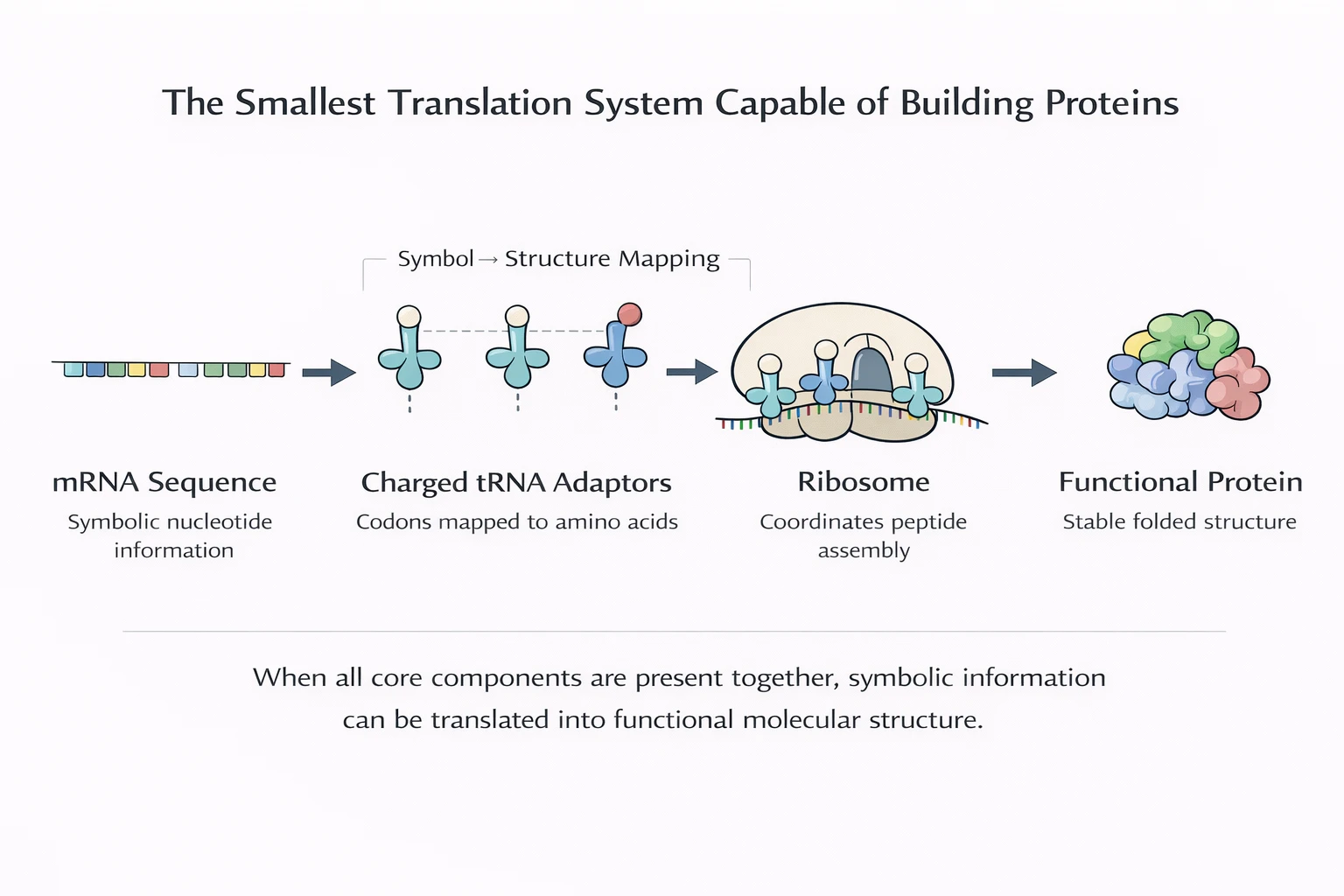
In modern biology, translation looks modular on paper (charging → initiation → elongation → termination → folding). In practice it’s tightly coupled:
- Charging depends on accurate mapping (tRNAs + synthetases + energy)
- Ribosome function depends on correctly assembled RNA/protein complexes
- Elongation depends on a steady supply of correctly charged tRNAs
- Termination depends on reliable stop recognition and recycling
- Folding & QC prevent toxic accumulation and enable reuse of resources
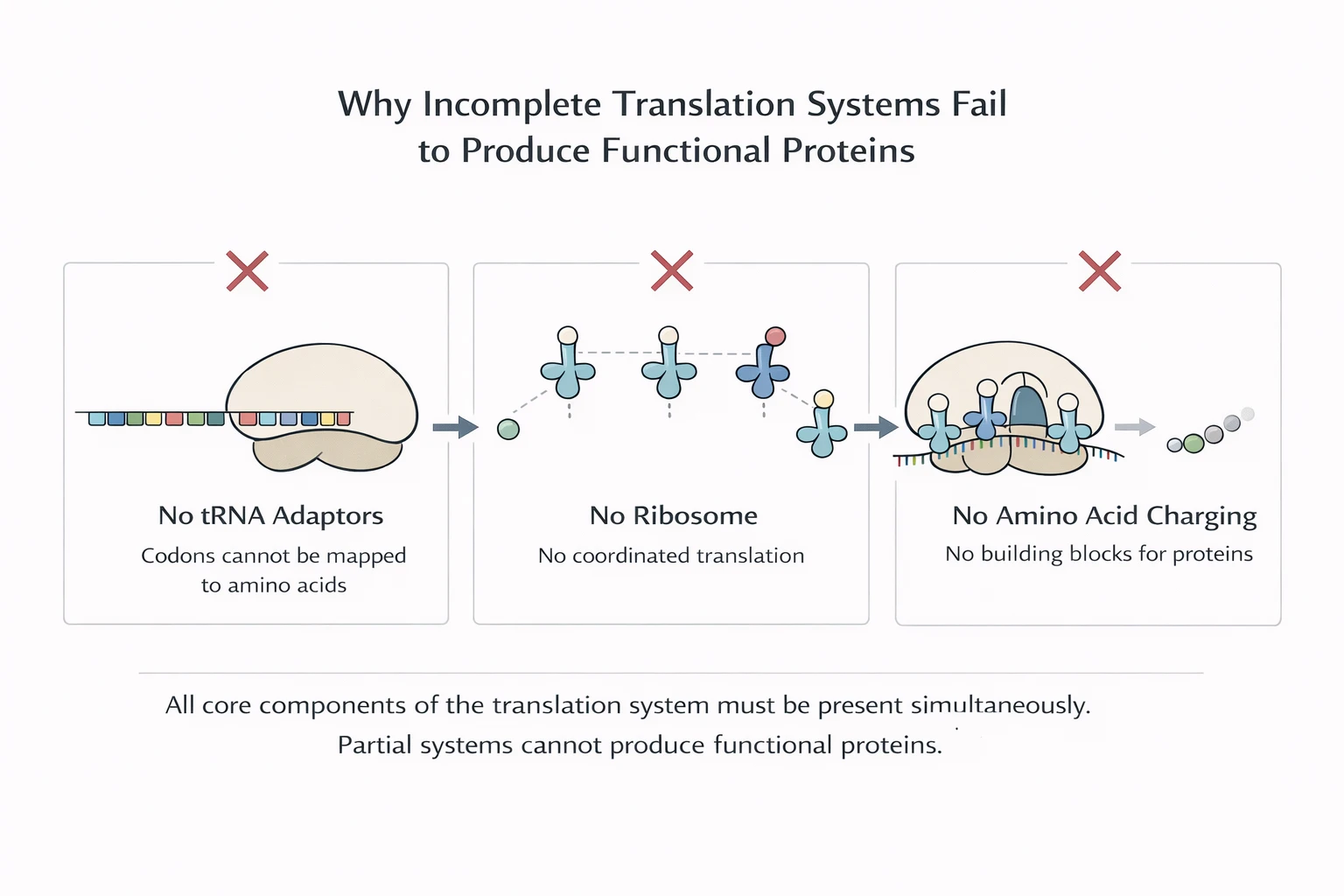
Break one link, and the system does not degrade linearly. It can stall, jam, or poison its own output. Translation is a threshold system, not a sliding scale.
3) Bootstrapping: the chicken/egg is real because it’s operational
The central dilemma is not rhetorical. It is operational and causal:
- Code without translation cannot express functional catalysts.
- Catalysts without code cannot be reliably replaced, refined, or inherited.
You can imagine partial solutions (ribozymes, peptidated ribozymes, simplified codes), but each introduces the same question at a new level: how does the system cross the threshold from fragile chemistry to inheritable, self-reinforcing functionality?
Practical framing
“Stepwise” only helps if each step is stable enough to persist and useful enough to be favored. Otherwise the process resets.
4) Error thresholds: fidelity is not cosmetic
Every layer has an error rate: charging mistakes, reading errors, frameshifts, premature stops, misfolding, aggregation. A working translation system must stay below a survivable error threshold, or it enters an “error catastrophe” regime where defective products dominate.
That creates a hard constraint: early systems must be good enough to persist before they can improve. But persistence already requires considerable structure.
5) Control loops: Phase 2 contains logic, not just chemistry
The deeper you look, the more Phase 2 resembles protocol enforcement:
- the reading frame must be maintained
- incorrect pairings must be rejected or corrected
- stalled machines must be rescued
- bad products must be triaged (refold vs degrade)
- resources must be recycled
None of this requires conscious intent. But it does require implemented constraint logic embedded in molecules and assemblies.
Why this matters
A story that explains “parts” but not “governance” explains the wrong thing. Phase 2 is governance of production under scarcity, damage, and noise.
6) The environment is not a neutral stage
Even granting prebiotic availability of building blocks, the environment is double-edged: it enables chemistry, and it destroys products. Heat accelerates reactions and degrades RNA. UV can drive synthesis and cleave polymers. Water enables folding and hydrolysis.
Phase 2, therefore, is not just “find the right sequence.” It is “keep the right sequences intact long enough to matter,” while avoiding runaway junk accumulation.
7) Innovation bandwidth shrinks inside protection
Protection is necessary — cavities, vesicles, gradients, compartments. But protection also narrows the sampling of chemical space. A system inside an enclosure has fewer attempts per unit time, fewer inputs, and fewer resets.
This tradeoff is central:
- Outside: more raw diversity, less stability
- Inside: more stability, less innovation bandwidth
8) Dependency closure: the “minimum set” is not small
Nobody knows the absolute minimum set for a self-sustaining translation system. But Phase 2 pushes you toward a closure condition: a set of components that can jointly (a) make proteins and (b) maintain the conditions for making proteins again.
Even under simplified assumptions, closure tends to require:
- a mapping mechanism (tRNA-like adaptors and charging logic)
- a reading mechanism (ribosome-like frame enforcement)
- energy coupling
- recycling / turnover
- error containment
One sentence summary
Phase 2 is hard because it requires a self-maintaining translation ecosystem — a closure of dependencies — not a single lucky molecule.
9) What this page is for (reader orientation)
This page functions as the “map legend” for Phase 2. After reading the individual pages, a reader should be able to see the shape of the problem:
- why partial solutions tend to collapse
- why control and recycling are as central as catalysis
- why “improbable” here often signals incomplete system-level closure
From here, the natural next page is a set of explicit bootstrapping scenarios: what could be simplified, what must co-exist, and what remains an open constraint.