Entangled Reality

The Intellectual Atlas

A structural map of the project’s central claim: order is not merely visible form, nor merely lawful possibility, but the emergence of stable relational structure within a deeper grammar of constraint.

What this page is for

This page serves as the conceptual center of Entangled Reality. It is not an essay and not a domain-specific argument. It is a map of the framework itself: the layered structure through which order becomes possible, persistent, and visible.

Across physics, biochemistry, neural systems, social life, and artificial intelligence, the same pattern recurs. Laws define what is possible. But possibility alone does not yield enduring order. Relationships must also be maintained.

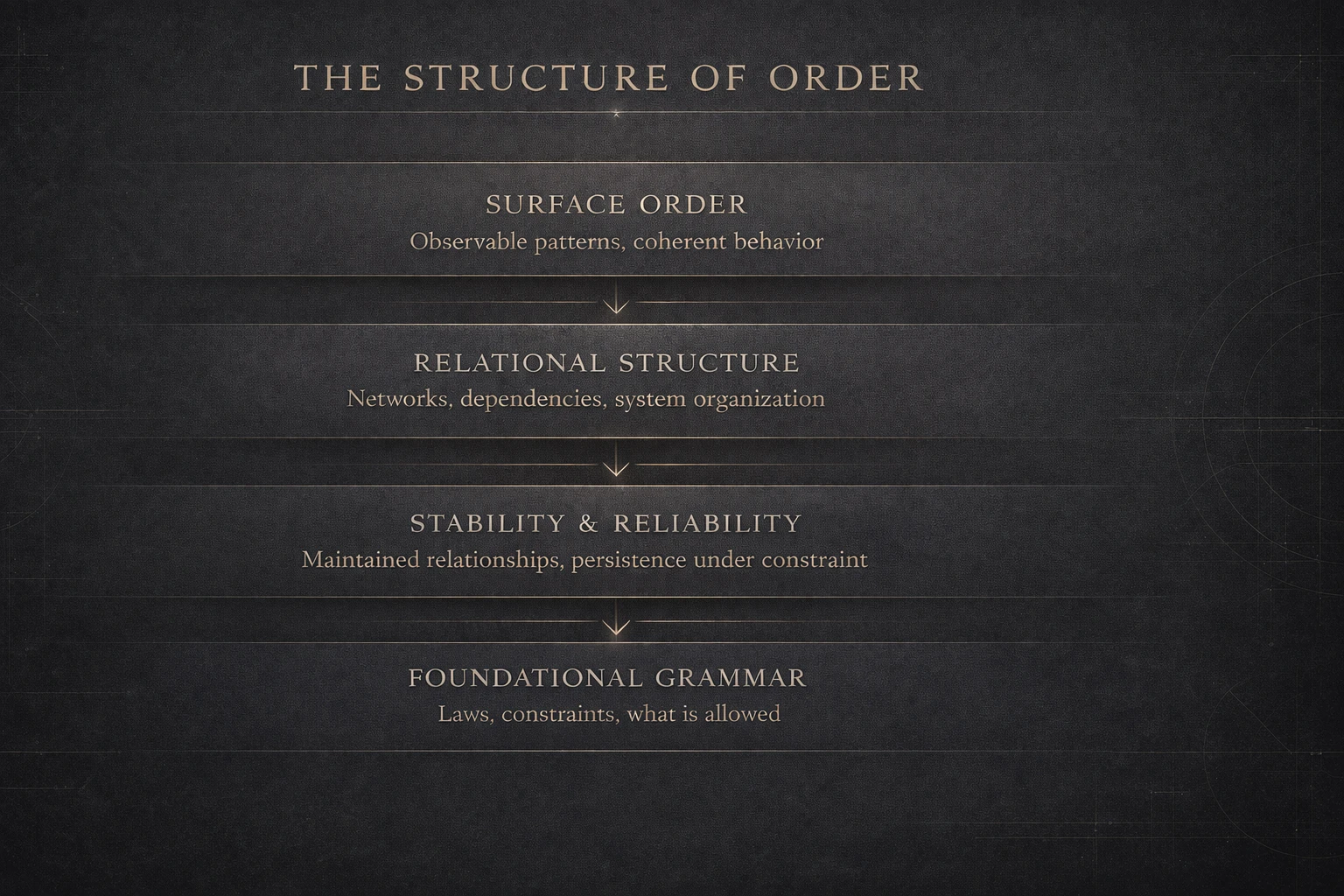
The Structure of Order: a four-layer conceptual framework showing Foundational Grammar, Stability and Reliability, Relational Structure, and Surface Order
Order emerges through layered constraint and maintained relationships. Laws define what is possible, but stability determines what persists, enabling relational structure to produce visible order.

Layer Definitions

Each layer answers a different question. Together they form a reusable framework for interpreting the essays, diagrams, and domain-specific arguments throughout the site.

Layer 1

Foundational Grammar

The lawful structure that defines what kinds of relationships are possible.

  • Physical law
  • Chemical constraint
  • Energetic limitation
  • Formal boundary conditions

This layer does not explain every realized system by itself. It establishes the constraint space within which all higher-order structure must arise.

Layer 2

Stability & Reliability

The maintained realization of relationships across time and disturbance.

  • Constraint-consistent
  • Repeatable under similar conditions
  • Robust under perturbation
  • Capable of preserving structure

This layer is the missing bridge between lawful possibility and persistent order. Not everything permitted by the grammar becomes real. Not everything real persists.

Layer 3

Relational Structure

The organized pattern of interdependence through which systems function.

  • Networks
  • Dependencies
  • Roles and coordination
  • Distributed or concentrated coherence

This is the level at which order becomes architectonic. Structure is no longer merely possible; it is arranged, coordinated, and operational.

Layer 4

Surface Order

The visible appearance of underlying relational coherence.

  • Observable regularity
  • Functional integration
  • Coherent behavior
  • Stable form and outcome

This is where order appears to us directly. But visible order is never self-grounding. It rests on hidden structures and deeper constraints below the surface.

How the framework applies across domains

The point of this atlas is not to flatten all disciplines into one another, but to show a recurring structural pattern: visible order depends on maintained relationships within lawful constraint.

Physics

Physical law defines possible interactions, but not every possible configuration is stable. Order emerges where trajectories, correlations, or equilibria can persist.

Biochemistry

Chemistry makes bonding possible, but living systems depend on highly constrained and reliable relational machinery: enzymes, translation systems, proofreading, regulation, and coordinated metabolic flow.

Neural Systems

Intelligence does not arise from isolated nodes, but from weighted, maintained, dynamically stable relations across the network.

Family / Society

Social order is not just rule declaration. It depends on maintained trust, reciprocal reliability, role fidelity, and the preservation of relational bonds under strain.

Artificial Intelligence

Capability alone is not enough. A durable AI order requires constrained behavior, stable alignment, bounded roles, and systems that remain reliable under changing inputs and pressures.

Why this matters

The modern habit is to explain order too quickly at the surface. The atlas slows that reflex down. It asks what deeper relations must exist, and what deeper conditions must hold, for visible coherence to appear at all.

This atlas will continue to expand. Over time, it should become the site’s central conceptual reference point: a place where readers can orient themselves before descending into the more detailed arguments, diagrams, and domain-specific examples.