Entangled Reality

Biochemistry / Phase 2 / AARS Charging

AARS Charging & Proofreading

The genetic code is not just a lookup table. It’s a rule enforced in chemistry. Aminoacyl-tRNA synthetases (AARS) are the enforcement layer: they charge tRNAs with the correct amino acids, often with proofreading to keep errors below catastrophic thresholds.

Topic: mapping → enforcement Key idea: charging is the “meaning” step Constraint: error control + ATP cost Bridge: translation system → origins dilemma

Choose your level

This page is written in layers. Pick your preferred depth and reading style. (Nothing is tracked; this only changes what your browser shows.)

Tip: you can also just open the expandable sections below.

1) The core claim

Translation only works if the same codon reliably yields the same amino acid in practice. AARS enzymes make that reliability real: they attach (“charge”) the correct amino acid onto the correct tRNA.

A codon table doesn’t do anything by itself. The decisive step is charging: an AARS enzyme recognizes a specific tRNA and attaches the correct amino acid to its acceptor end, using ATP. That is where “meaning” is enforced.
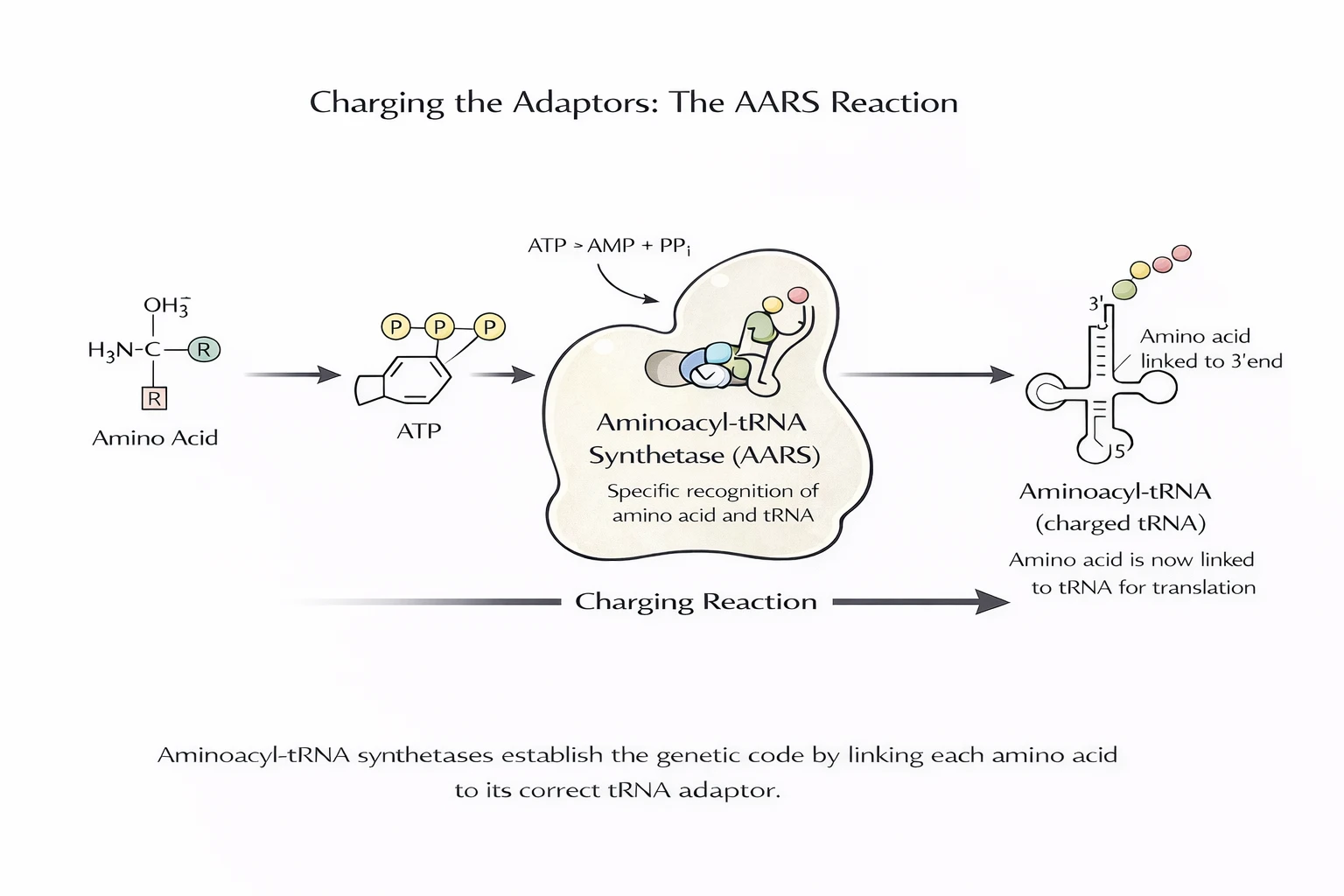
Aminoacyl-tRNA synthetase charging reaction using ATP to attach the correct amino acid to its cognate tRNA
Aminoacyl-tRNA synthetases enforce the genetic code by using ATP to attach the correct amino acid to the correct tRNA adaptor before translation begins.

Charging alone is not sufficient. Many amino acids are chemically similar, so additional enforcement is required to prevent systematic mistranslation.

This is why many AARS enzymes include additional recognition and editing steps that actively reject incorrect substrates.

Aminoacyl-tRNA synthetase proofreading rejecting near-cognate amino acids before or after tRNA charging
Many AARS enzymes include proofreading (editing) sites that reject chemically similar but incorrect amino acids, preventing error accumulation before proteins are built.
Takeaway: “Genetic code” is data plus enforcement. AARS provide both initial assignment and error correction.

Think of the genetic code as a mapping that must be executed with low enough error to sustain replication and selection. The ribosome reads codons, but it does not “know” amino acids. It accepts whatever amino acid is carried by the tRNA that matches the codon. That means the genetic code is functionally implemented upstream at the charging step: AARS enzymes bind (i) an amino acid and (ii) the correct tRNA identity, then use ATP to covalently attach them.

If this enforcement fails—even modestly—translation becomes noisy, proteins misfold, and catalytic networks destabilize. From an origins standpoint, the key question becomes: how do you get a stable, self-maintaining mapping early enough for cumulative selection to operate on proteins at all?

The ribosome enforces reading. AARS enforce semantics (codon → amino acid) by establishing tRNA identity. Without charging, codons have no biochemical meaning.

Translation is a two-step constraint system: (1) the ribosome enforces a triplet reading frame; (2) AARS enforce the mapping between tRNA identity and amino acid identity.

tRNAs are not mere adapters; they are typed tokens. AARS enzymes are the type-checkers and (often) the proofreaders. They must distinguish among dozens of tRNAs, some of which share amino acids but use different anticodons.

In modern systems, fidelity emerges from layered constraints: identity elements in tRNA (acceptor stem, anticodon loop, discriminator base), AARS binding pockets tuned to amino acid chemistry, and—in certain cases—editing domains that hydrolyze near-cognate misactivations.

This is not just “an enzyme exists.” It is a distributed logic that must be coherent across: tRNA structures, AARS families, ATP-driven activation chemistry, ribosome acceptance rules, and downstream folding/quality control. The informational bottleneck is therefore not only a codebook, but the emergence of a stable enforcement network.

Gloss
Charging: AARS + amino acid + ATP + tRNA → aminoacyl-tRNA
Why ATP?
Bond formation is energetically expensive; ATP couples energy to specificity.
Failure mode
Uncharged tRNA → stalled translation at that codon; mischarged tRNA → wrong amino acid inserted.
2) Charging as “meaning”: what actually happens

An AARS enzyme performs two coordinated recognitions: it must bind the correct amino acid and the correct tRNA identity, then join them using ATP. The product is an aminoacyl-tRNA—a tRNA “charged” with an amino acid.

Key point: the ribosome mainly checks codon–anticodon pairing. If a tRNA is mischarged, the ribosome can still accept it—meaning the code is enforced upstream by AARS.

Amino acid + ATP + tRNA  --(AARS)-->  aminoacyl-tRNA + AMP + PPi

Then:
mRNA codon + (matching) tRNA anticodon  --(ribosome)-->  amino acid inserted into the growing chain

In modern cells, the charging step is an energy-expensive commitment to meaning: the system pays ATP to reduce ambiguity.

3) tRNA recognition: “typed tokens,” not generic adapters

tRNAs carry both a codon-matching anticodon and a set of structural “identity elements” that allow the correct AARS to recognize them. Recognition is distributed across features such as:

  • Acceptor stem geometry and base pairs
  • Anticodon loop (sometimes used, sometimes not the primary cue)
  • Discriminator base (often near the acceptor end)
  • Overall folding/shape of the tRNA

This matters because many amino acids correspond to multiple codons, which can imply multiple tRNAs. The “correctness” of translation depends on AARS reliably choosing the right tRNA among dozens of similar molecules.

Systems view: “codon → amino acid” is implemented as “codon → tRNA identity” (ribosome), plus “tRNA identity → amino acid” (AARS).
4) Proofreading: why “close enough” is not close enough

Some amino acids are chemically similar. That makes misactivation a real risk. Several AARS enzymes include an editing function: a second site can hydrolyze incorrectly attached amino acids (or misactivated intermediates) before they reach the ribosome.

A canonical example is the isoleucine/valine problem: they differ subtly, but the consequences of systematic substitution can be severe. Editing is a way of paying extra biochemical cost to avoid runaway noise.

Why this matters for origins: an early system has to be “accurate enough” for proteins to be stably inherited. If the error rate is too high, any emergent catalytic advantage is washed out by noise.

You cited an overall error rate on the order of ~1 in 10,000 bindings as a reference point for modern systems. The exact number varies by enzyme and context, but the qualitative point holds: translation requires error control.

5) AARS snapshot: the enforcement layer is not small

Below is your Phase-2 table, retained as a “scale reminder.” Even if we avoid exact organism-specific counts, the structural point is stable: many distinct enzymes exist, and they are not tiny.

Note: lengths shown are amino-acid residue counts as listed in your draft.
Name of AARS Enzyme Amino Acid Code Length
Arginyl-tRNA synthetaseArginineR577
Cysteinyl-tRNA synthetaseCysteineC461
Glutamyl-tRNA synthetaseGlutamic AcidE471
Glutaminyl-tRNA synthetaseGlutamineQ554
Isoleucyl-tRNA synthetaseIsoleucineI938
Leucyl-tRNA synthetaseLeucineL860
Methionyl-tRNA synthetaseMethionineM677
Tyrosyl-tRNA synthetaseTyrosineY428
Tryptophanyl-tRNA synthetaseTryptophanW334
Valyl-tRNA synthetaseValineV951
Alanyl-tRNA synthetaseAlanineA878
Aspartyl-tRNA synthetaseAspartic AcidD590
Asparaginyl-tRNA synthetaseAsparagineN466
Glycyl-tRNA synthetase (alpha subunit)GlycineG303
Histydyl-tRNA synthetaseHistidineH424
Lysyl-tRNA synthetase (constitutive)LysineK505
Phenylalanyl-tRNA synthetase (alpha subunit)PhenylalanineF327
Prolyl-tRNA synthetaseProlineP572
Seryl-tRNA synthetaseSerineS430
Threonyl-tRNA synthetaseThreonineT642

The point isn’t that modern counts must be projected back unchanged; it’s that translation fidelity depends on a set of typed recognitions. If even one amino acid lacks a workable charging path, translation can stall at any codon that requires it.

6) Origins pressure: why AARS are a “Phase 2” bottleneck

Your broader argument is that origins-of-life models have to account not only for “informational polymers” but for a translation system that can reliably convert code into functional catalysts fast enough to outrun equilibrium.

AARS intensify the bootstrapping problem: they are proteins produced by translation, yet translation depends on their charging rule. Proposed bridges (ribozymes, peptidated ribozymes, simplified codes, urzyme hypotheses) are attempts to reduce the initial enforcement burden—but the system still requires coherence: a stable mapping must exist early enough for cumulative selection to operate on proteins at all.

Framing sentence for the site: Protein synthesis is not merely “chemistry happening.” It’s a choreography where meaning is enforced. AARS are a central enforcer.

This is the point where your simulation demo naturally fits: it’s a way of asking whether stepwise movement in sequence space can plausibly preserve “enough” interim coherence to keep a mapping from diffusing into noise.

Next steps

Recommended sequence after this page: Reading frame & ribosome constraintsError control & folding/QCBack to origins dilemma.