Bootstrapping Scenarios

How could a fragile chemical environment cross the threshold into inheritable functionality— where translation can reproduce its own machinery and persist under noise, drift, and damage?

Threshold Closure Fidelity Energy coupling
Phase 1 • Prebiotic Chemistry Phase 2 • Translation System Phase 3 • Evolution & Selection

Switch the controls to reveal different layers of explanation (same page, different depth).

1) What “bootstrapping” means here

Bootstrapping means crossing from chemistry to a system that can keep going: it makes proteins and can rebuild the machinery that makes proteins.

Bootstrapping is the transition from fragile chemistry to inheritable functionality. In this framework, inheritable functionality begins when a translation system can reproduce the machinery that enforces its own code→protein mapping, so gains persist instead of resetting.

In short: translation becomes “real” when it can rebuild itself faster than drift and damage erase it.

“Bootstrapping” here is a closure condition. A translation regime must (a) instantiate a stable mapping, (b) execute synthesis with throughput and fidelity above a survivable threshold, and (c) regenerate the components that implement those constraints (adaptors, charging/enforcement, reading-frame control, energy coupling, and turnover) at rates that outrun decay.

This is why the Phase-2 bottleneck is not “a part exists once,” but “a regime exists that can persist across cycles of damage and replacement.”

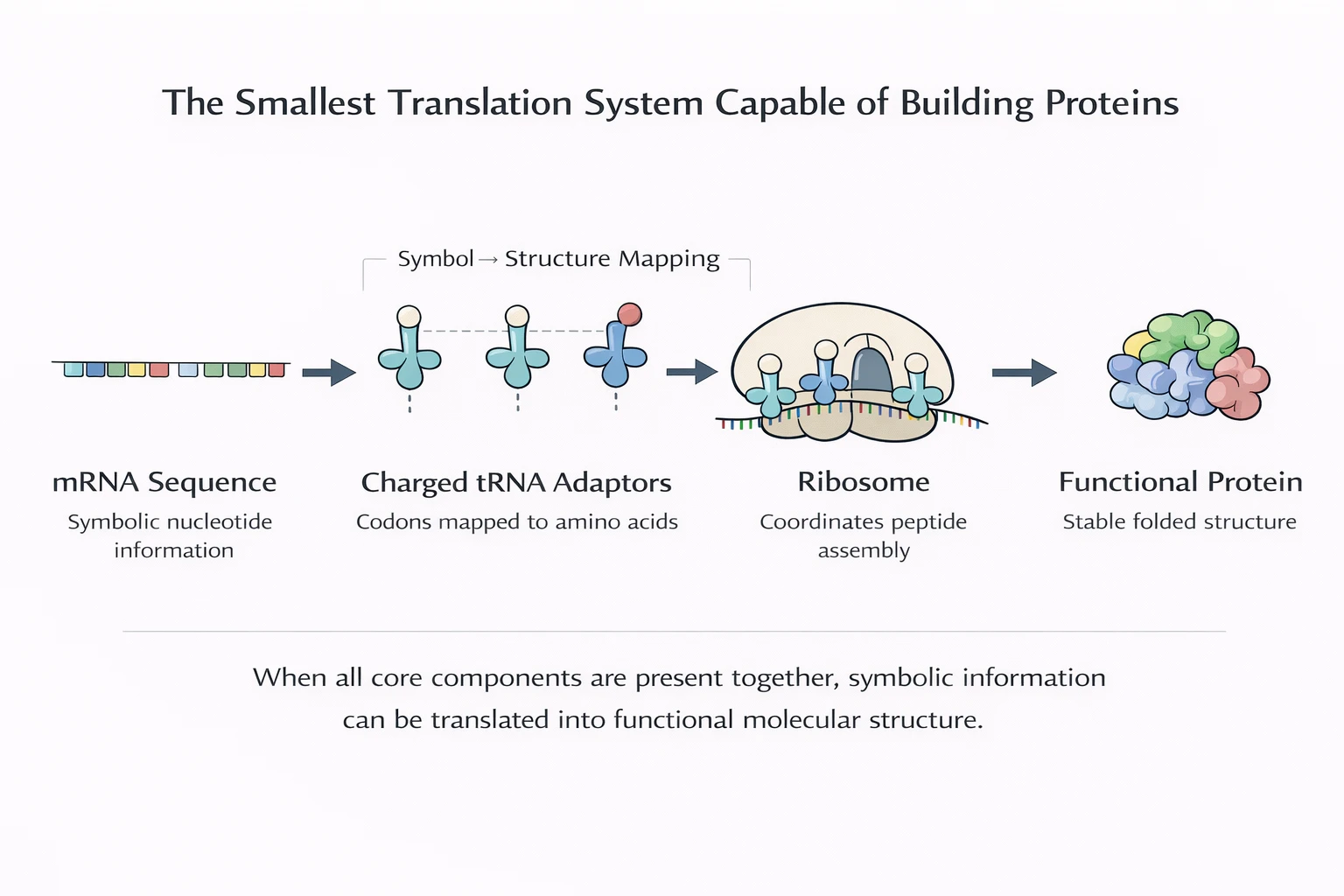
Minimal translation system dependency closure: template, adaptors, charging enforcement, ribosome frame control, and energy coupling
Bootstrapping targets a closure condition: the coupled dependencies that must co-exist for translation to persist.

2) The threshold problem

Early systems must be good enough to persist before they can improve.

Stepwise improvement only helps if intermediate steps are stable enough to survive and useful enough to be favored. Below a certain threshold, errors and decay dominate: the system resets before it can accumulate advantage.

  • Throughput: enough correct product per unit time
  • Fidelity: error rates below an “error catastrophe” regime
  • Recovery: repair/rescue/recycling instead of runaway failure
  • Energy coupling: work must be paid for reliably

The relevant “threshold” is not a single number. It is a region in a multi-dimensional trade space: translation accuracy vs speed; mapping stability vs exploration; compartment protection vs sampling bandwidth. A bootstrapping pathway must enter a region where the expected value of rebuilding the apparatus is positive under environmental noise (hydrolysis, UV, thermal cycling, dilution, parasitism, etc.).

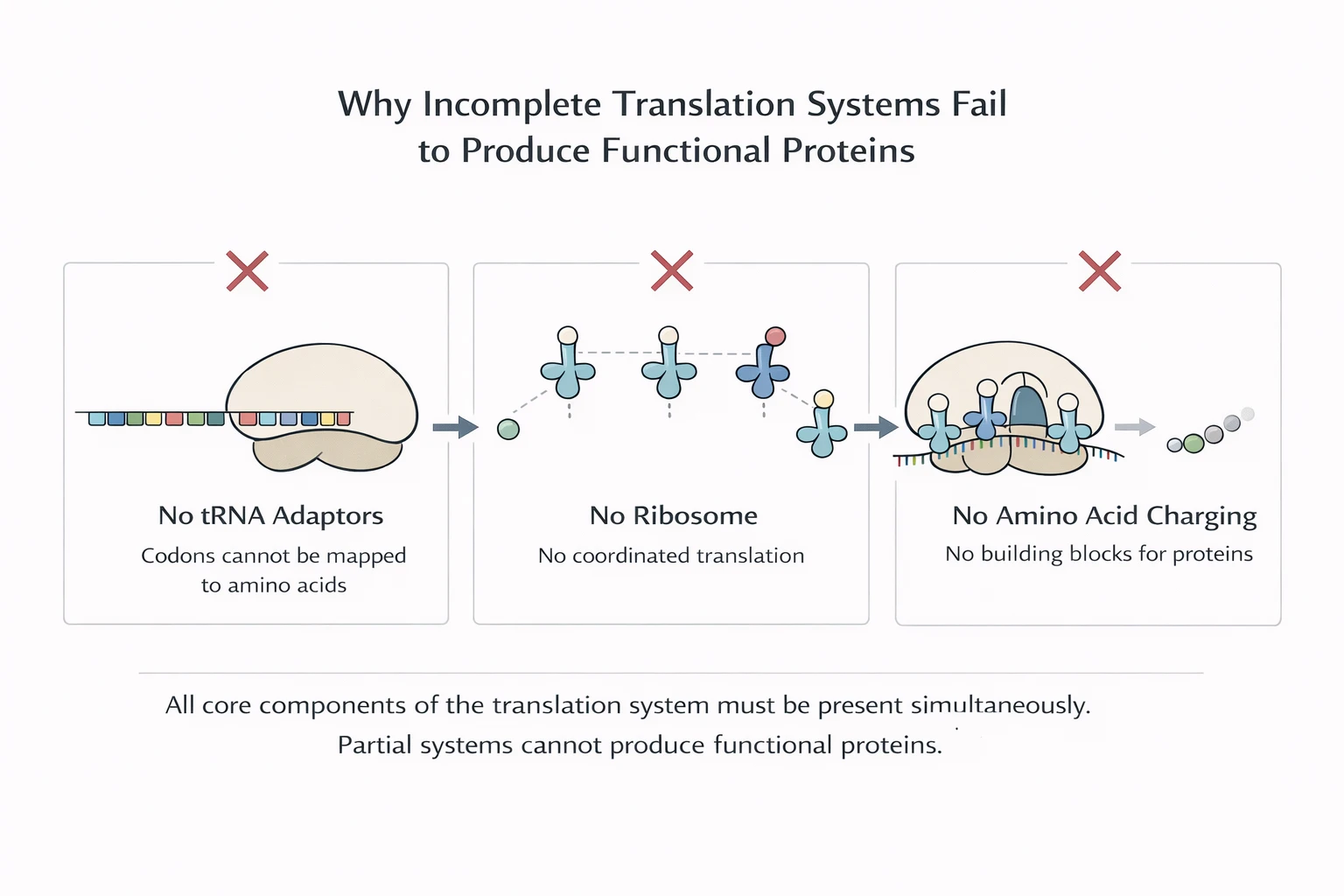
Incomplete translation systems failing when key dependencies are missing, illustrating tight coupling and failure propagation
Below threshold, missing or unstable links don’t degrade gracefully: failure propagates and the system collapses or resets.

3) Sparse function landscapes (why “most sequences” are noise)

Proteins only work when they fold into stable shapes. Most random amino-acid sequences don’t fold into anything useful—so “function” sits on rare islands inside a vast sea of noise.

Enzymes work because a sequence produces a specific 3D fold—a tightly constrained pattern of attractions and repulsions (hydrophobic packing, charge interactions, hydrogen bonds) that yields a stable structure and, sometimes, an active site.

This creates a harsh asymmetry: changing the sequence usually changes the fold, and a broken fold usually means lost function. In other words, the search space is dominated by sequences that are unstable, misfolded, aggregated, or non-catalytic. Functional proteins occupy sparse “islands” in sequence space rather than a smooth landscape.

Why this matters for bootstrapping

A translation system doesn’t just need to exist—it must reliably produce proteins that land in the functional regime often enough to sustain and rebuild the system itself.

The constraint is not merely combinatorial (“many possible sequences”), but structural: function is mediated through fold stability and geometry. Most sequences fail to form a cooperative, kinetically accessible fold, or they form folds that lack catalytic features. Small substitutions can rewire interaction networks, destabilize cores, or distort active-site geometry—often collapsing activity rather than smoothly degrading it.

This makes early evolution especially demanding. Before a lineage has reliable translation and repair, the system must repeatedly sample sequences—but the probability mass is concentrated in nonfunctional space. A viable pathway therefore needs both (a) a way to generate variation and (b) a way to retain rare gains long enough for cumulative improvement (i.e., closure under replacement and turnover).

Working takeaway

Phase 2 is a double threshold: closure (self-maintaining translation) inside a sparse functional landscape (rare stable catalytic folds).

4) Bootstrapping scenarios (what they simplify—and what remains)

The scenarios below are not “solutions.” They are lenses. Each one reduces some burden while leaving core constraints intact. The key question is always the same: does the pathway reach inheritable functionality before noise erases it?

Scenario A — A simpler code (reduced alphabet)

Start with fewer amino acids or simpler assignments, then expand later.

A reduced code lowers the size of the search space and may ease early fidelity requirements. Fewer distinct assignments can mean fewer ways to fail.

Remaining constraint: the system still needs enforcement. A smaller mapping still must be stable, reproducible, and resistant to drift.

Doesn’t go away: a reproducible mapping apparatus (adaptor + charging logic + reading/frame control).

Even a “two-letter” or “few-amino-acid” code must avoid systematic misassignment. Reduced alphabet helps, but it doesn’t remove the need for a repeatable association mechanism that persists under parasitism and mutation. The question shifts from “20 amino acids” to “how is any mapping stabilized and inherited?”

Scenario B — RNA catalysis first (ribozymes do more work)

Let RNA do the catalysis early, then introduce proteins later.

RNA can store information and catalyze reactions. In principle, early ribozymes could support partial metabolism and rudimentary templating.

Remaining constraint: the hard part is still crossing into a regime where proteins become reliably producible and the translation apparatus becomes regenerable.

Doesn’t go away: the threshold where translation becomes self-maintaining rather than episodic.

The RNA-world framing shifts the “how do we get catalysts?” question, but it does not solve the “how do we get a stable mapping?” question. A system that sometimes makes peptides is not yet inheritable functionality unless it can reproduce the translation regime with sufficient reliability to accumulate improvement.

Scenario C — Peptide-assisted RNA (hybrid regimes)

Small peptides help RNA catalysis and stabilize structures, creating feedback loops.

Hybrid regimes are attractive because they allow incremental gains: peptides stabilize ribozymes, ribozymes template peptides, and compartments protect both.

Remaining constraint: feedback loops only “count” if they are inheritable: the regime must reproduce the machinery of the loop, not merely benefit from it once.

Doesn’t go away: closure across production + maintenance (repair, turnover, enforcement).

Hybrid scenarios can reduce some improbability by allowing intermediate functionality. The critical question becomes whether hybrid loops can be insulated from drift and parasitism long enough to cross the self-maintenance threshold (especially where mistranslation produces toxic products).

Scenario D — Compartment protection (vesicles, pores, gradients)

Enclosures protect fragile molecules—but they also reduce exploration.

Compartments (vesicles, mineral pores, micro-environments) protect products from dilution and degradation, and can concentrate reactants.

Remaining constraint: protection also shrinks sampling bandwidth. The system now has fewer “tries” per unit time and must manage resource economy, recycling, and error containment inside the enclosure.

Doesn’t go away: crossing the threshold before resources and errors saturate the compartment.

Compartmentalization trades off innovation for stability. Early regimes must remain open enough to acquire inputs and expel waste, while closed enough to retain useful intermediates. This becomes a control problem: boundary conditions, selective permeability, and turnover.

5) What this page is saying (without overstating it)

The question is not whether intermediates exist. It is whether they reach a stable, inheritable regime.

Bootstrapping is not “a lucky molecule.” It is a transition into a regime where enforcement, repair, and regeneration outrun decay. Many proposed intermediates are plausible. The constraint is whether the system crosses the survivable threshold before noise erases it.

One sentence: Stepwise only helps if each step is stable enough to persist and reproducible enough to be inherited.

This framing does not “disprove” pathways. It specifies the missing requirement that any pathway must satisfy: closure under replacement. If the mapping apparatus cannot be regenerated with adequate fidelity, improvement cannot accumulate. The result is episodic chemistry rather than lineage.