The Three Phases
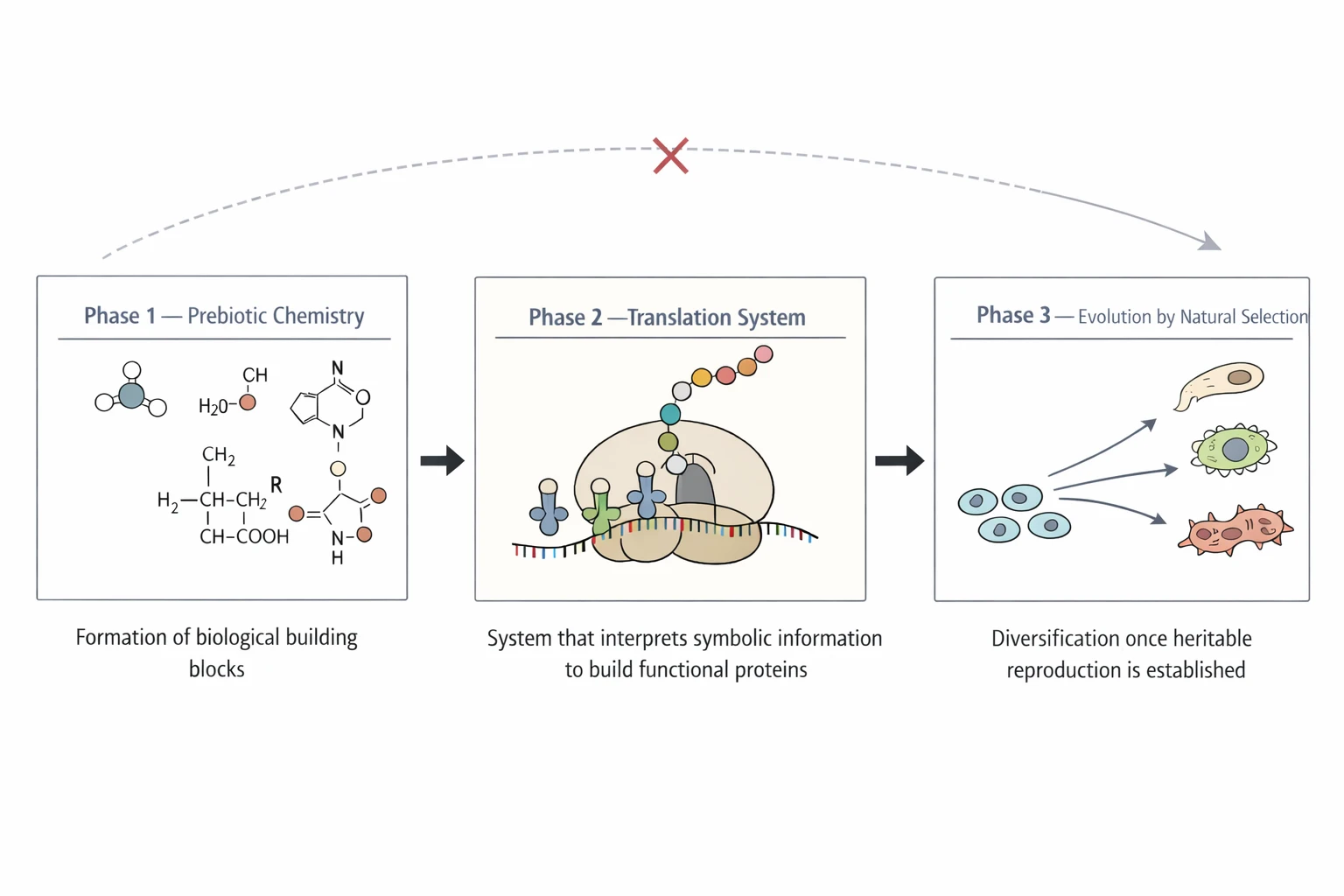
In South Park, the underpants gnomes have a business plan: Phase 1: collect underpants; Phase 3: profit. The problem is Phase 2 — the missing causal chain. In origins-of-life discussions, we often have a Phase 1 and a Phase 3 as well, and the real dispute concentrates in the middle.
What “three phases” means on this site
Phase 1 covers plausible prebiotic ingredients and environments (chemistry, energy sources, compartments). Phase 2 covers the emergence of translation logic — reliable mapping from code to catalytic structure and the machinery needed to sustain and reproduce that mapping. Phase 3 is the claim that life (a sustained disequilibrium capable of reproduction) emerged from non-living matter by natural processes.
Ingredients & constraints
What the early Earth could plausibly provide: building blocks, energy gradients, compartments, and stability. This phase is about chemistry and environment — the “inventory” and the “workbench.”
- Availability of nucleotides and amino acids
- Compartmentalization (pores, vesicles, membranes)
- Stability problems (UV, hydrolysis, heat)
Translation logic
The missing causal chain: how one-dimensional sequences become reliable, reproducible three-dimensional catalysts — and how that whole system persists long enough to reproduce.
- Code → structure mapping (genetic code)
- tRNA, AARS, ribosome, factors
- Folding, chaperones, QC, energy supply
Abiogenesis claim
The conclusion some narratives move toward: that life emerged and stabilized (and then diversified) through natural processes. This is the “profit” end of the story.
- Sustained disequilibrium
- Replication and heredity
- Selection becomes operational
Why Phase 2 carries most of the explanatory weight
Phase 1 can be rich in ingredients, and Phase 3 can describe the world once life exists. But the story stands or falls on whether Phase 2 is even remotely plausible: a translation system has to be stable enough to reproduce itself, but flexible enough to evolve.
You can’t get cumulative selection without reproduction, and you can’t get reproduction (of complex functional machinery) without something like translation. That’s why “origins” isn’t just “evolution earlier.”
People smuggle Phase 3 certainty into Phase 2 by assuming the existence of selection, heredity, and robust replication before explaining how those things arose.
The point of the “three phases” map isn’t to score points. It’s to keep the causal chain visible: what is assumed, what is explained, and what is still a placeholder.
Quick clarifications
Is this saying evolution by natural selection is false?
No. This framing treats selection as powerful and well-supported where it applies. The question is what selection can explain before reliable reproduction and translation exist.
Why not just treat “RNA world” as Phase 2?
“RNA world” proposals often address aspects of Phase 1 and hint at bridges toward Phase 2. But Phase 2, as used here, is specifically about a stable, reproducible mapping from sequence information to catalytic function — i.e., translation logic (even if primitive or partially RNA-based).
Where should this page be linked from?
Link it from both Evolution and Phase 2 landing pages. That way “Phase 2” never appears as unexplained jargon, no matter where a reader enters.
Continue
Pick your entry path — reader-first (selection) or concept-first (translation bottleneck).